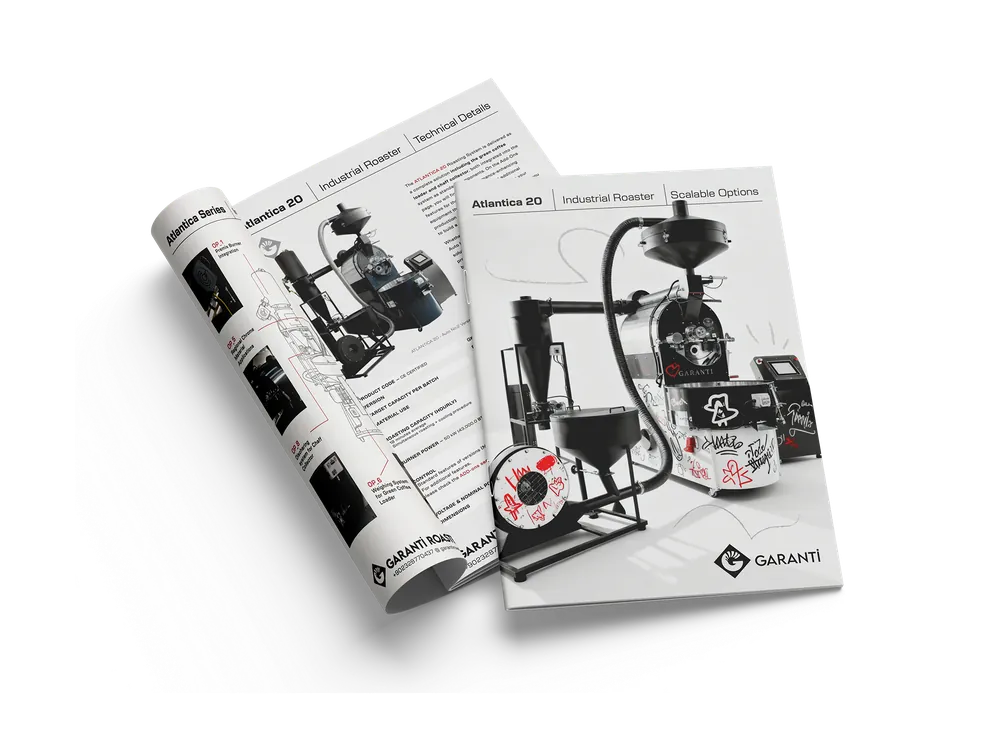
Coffee Roasting System Flow
Capacity is only the beginning. A professional roasting line must work as a complete system — from green coffee loading to roasting, cooling, destoning, emission control and final production.

Most roasting investments start with one question: “Which capacity do we need?”
It is a valid question — but not the final one. A 20 kg, 30 kg or 60 kg roaster does not define the real performance of a facility by itself.
Real performance comes from the full system flow: how coffee is loaded, roasted, cooled, cleaned, transferred, ground and prepared for production.
The System Starts Before the Roaster
A roasting line begins before the first batch enters the drum. Green coffee loading affects speed, operator comfort, workflow discipline and production continuity.
Manual loading may be enough for small operations. But as production grows, the loading process becomes part of the system — not a side task.
Capacity Is Not the Whole Story
Batch capacity tells you the size of the drum. It does not tell you how efficiently the full line will perform during daily production.
- Roast profile and roast degree
- Loading and discharge speed
- Cooling performance
- Operator workflow
- Destoner and transfer integration
- Grinding and packaging needs
- Automation and repeatability
Design the Flow, Not Only the Machine
The stronger question is not “Which roaster should we buy?” It is: “How should our roasting line work from green coffee intake to final product?”
Destoning Is a Quality Control Step
Roasting does not end when coffee leaves the drum. After cooling, roasted coffee must move safely into the next stage of production.
A destoner helps remove heavier foreign materials from roasted coffee. It protects downstream equipment, supports product safety and adds another layer of control to the production line.

Why Does a Destoner Matter?
In professional roasting operations, even a small foreign material risk should be taken seriously. A destoner is not only about removing stones. It also helps protect downstream equipment and strengthens quality control.
Emission Control Should Not Be an Afterthought
Coffee roasting creates smoke, odor, particles and exhaust gases. That makes ventilation and emission control part of the investment from the beginning.
The roaster, afterburner and ventilation line should be planned together. A strong roasting machine without a suitable exhaust solution can create operational problems later.
The Correct Approach
The coffee roaster, afterburner and ventilation line should be planned as one connected system. When the exhaust side is treated separately, the whole operation may lose efficiency, safety and environmental control.

Consistency is engineered. It comes from controlled heat transfer, reliable equipment, trained operators and a system that can repeat successful roast profiles.
A Roasting Line Should Work as One System
Not every business needs a full production line on day one. But every serious investment should be planned with the next stage in mind.
When one step is missing or poorly planned, the whole operation slows down. A roasting system should solve today’s production need while leaving room for tomorrow’s growth.
Choose the System, Not Just the Roaster
A coffee roasting investment should not be judged only by price, batch capacity or machine appearance. The real value is in how the complete system performs every day.
GARANTİ Roasters designs roasting solutions for different production levels — from shop roasters to industrial roasting systems. Our portfolio includes roasters, grinders, green coffee loaders, destoners, afterburners and automation solutions.
Planning a Roasting Facility?
Share your production target, coffee type and investment plan. We can help you build the right roasting system flow for your operation.
Get a Quote